
Home › Blog › Elopement and vow renewal
Elope in Vietnam for American Couples: Complete Planning Guide
By the Cáo Moments team · 2026-11-06
Eloping in Vietnam means marrying just the two of you (or a tiny group) in a location far more memorable than a courthouse: a terraced rice field at sunrise, a limestone cave, a private beach on an island, or a rooftop garden overlooking the river. Most American couples choose Vietnam for the low cost of coordination, the dramatic landscapes, mild weather in October–November or March–April, and the chance to honeymoon immediately after. An elopement typically runs one day or two, including a private dinner and photos, and Cáo Moments coordinates everything—venue, flowers, custom cake, decor, hidden photographer and videographer, music, and all logistics via WhatsApp in English—so you arrive, exchange vows, and celebrate without stress. The timeline is usually four to twelve weeks from booking to the day, though we work with shorter notice if needed. Cost depends on location, guest count, and services (ask us for a quote on WhatsApp); your main trade-off is often location proximity to Hanoi or Ho Chi Minh City, since remote sites need more setup time and backup weather plans. Chat with a planner on WhatsApp
Where do American couples elope in Vietnam most often?
Most American elopers choose one of four regions. Northern Vietnam draws couples to romantic Hanoi and the limestone karsts of Trang An for sunrise vows with mist rising off the water—dramatic, photogenic, accessible within 90 minutes from the capital. Central coast lovers pick Da Nang for beach ceremonies at dawn or Hoi An for lantern-lit riverside dinners after vows on the ancient bridge. Far south, Ho Chi Minh City couples often elope on nearby islands or rooftops and spend the night in the city. Phu Quoc, a three-hour flight south, suits pairs who want island privacy, turquoise water, and zero crowds—trade-off is travel fatigue and fewer same-day backup venues if weather turns. Each region has its own rain season: October–November and March–April are safest nationwide. We choose venues based on your "non-negotiable" (waterfall, mountains, sea, urban) and build a rain backup plan within the same landscape—for instance, if a mountain field floods, we pivot to a cave temple thirty minutes away.

What's the timeline for planning an elopement from the US?
You'll need four to twelve weeks: weeks 1–2 to decide location, date, vow style (intimate whisper or full ceremony script), and whether you want guests; weeks 2–6 to nail down elopement venue and dinner, flowers and bouquet, custom cake, and photography and video details via WhatsApp calls; weeks 6–10 to confirm outfits, music, any cultural touches, and rain contingencies; weeks 10–12 to rehearse timing, finalize arrival logistics, and brief your planner on what makes you laugh (so the videographer knows). Shorter timelines (three to six weeks) work if you're flexible on date and venue type. The biggest delay we see is couples overthinking venue choice—we recommend picking a region first (coast or mountains, north or south), then visiting three specific sites with us by video call, then deciding. Overthinking photography style also stalls planning; we say: book your photographer first, build the day around golden hour light, and the aesthetic follows naturally.
How does Cáo Moments keep your elopement secret from family?
Secrecy requires deliberate coordination. We ask you to share our WhatsApp contact with no one and to never mention us by name in group chats or social media before the day. We use a shared doc (only you and your planner see it) to lock down vow wording, flower colors, cake flavor, and song choices—no email trails family can intercept. If local vendors need to know venue details (florist, cake baker, musician), we brief them under a cover story: "private client dinner," never "elopement." We send you a detailed timeline two weeks before the day, with explicit "do not share" notes. The biggest risk is your partner's family calling the venue to "confirm" and the venue accidentally spilling the news—so we list the venue under a pseudonym in any reservation confirmation you see. WhatsApp calls (not texts) are our default for sensitive details, so there's no record to hack. Rain backup plans stay secret until forty-eight hours before, so no one worries or tries to "help" by suggesting cancellation. Most importantly: tell us if anyone in your family speaks Vietnamese or has Vietnam connections; we'll add extra caution steps.
What's your backup plan if it rains on the elopement day?
Rain is our most-managed variable. By mid-August 2026, we scouted every site and already built three backup locations within your chosen region—usually a roofed temple, a cave, an indoor gallery, or a resort pavilion that matches your original vibe. We brief you on the backup plan two weeks before; on the morning of, we call at 6 a.m. local time with a go/no-go decision based on live weather radar and site drainage checks. If we pivot to backup, the pivot happens within one hour—flowers are already en route to the backup, cake is already there, photographer meets you at the new spot. The only variable that rarely changes is your dinner reservation, since it's indoors; if the original venue is flooded, we move dinner to another rooftop or pavilion in the same city. We've never cancelled an elopement for rain; we've rescheduled two (couples chose to wait one day for clearer skies). Coastal venues are riskier in September; mountain and cave sites almost always work because water drains fast and light is diffuse. If you're wedding in a monsoon month (August–September in the north, May–September in the south), we recommend a cave, temple, or covered venue as your primary, not a fallback—costs the same, mood is just as intimate.
How do American couples handle legal marriage versus ceremony-only in Vietnam?
This is critical: Vietnam does not legally recognize elopements unless a Cáo Moments does a full civil ceremony with a local official, paperwork, two witnesses, and a marriage certificate you can file with US authorities (acceptable in most states). Most American couples we work with are already legally married in their home state or courthouse and come to Vietnam for a ceremonial redo—no stress, all joy, no paperwork. Some arrive unmarried and want a legal Vietnam ceremony; that requires a US visa extension (if needed), a Vietnam civil code expert (we refer you to a partner attorney), and three to five additional visits to a district office—total extra time is usually two to three weeks, which most couples avoid. Instead: many couples marry at a courthouse in their US city, keep it secret from family (same approach as elopement secrecy), and then elope ceremonially in Vietnam two to six months later with no legal complications. Our team can guide you on the legal angle during a WhatsApp call; we don't provide legal advice, but we've seen what works and what gets tangled. Choose early so we know whether you're planning a ceremony-only moment (ninety-nine percent of our elopements) or a legal ceremony (which changes vendor coordination and timeline).
What does a typical elopement day look like, hour by hour?
| Timing | What Happens | Who's There | What You're Wearing |
|---|---|---|---|
| 5:00 a.m. | Florist arrives at venue, sets up arch and bouquets; photographer does light test | Planner, photographer, florist | Robes, comfort |
| 6:30 a.m. | You arrive at venue; hair and makeup touch-ups outdoors or in a tent | You two, planner, photographer, videographer | Whatever makes you happy (robe, dress, suit—no rules) |
| 7:00 a.m. | First-look photos; couple's walk; vow rehearsal | You two, photographer | Pre-ceremony outfit |
| 7:45 a.m. | Musician starts; you take positions; witness (if any) and planner stand by | Everyone | Ceremony outfit |
| 8:00 a.m. | Vows, rings, kiss; celebration photos (bouquet toss, confetti, champagne toast outdoors) | You two, photographer, videographer, planner | Same |
| 9:00 a.m. | Transition to breakfast or rest at nearby hotel/café; photographer grabs detail shots of cake, flowers, rings | You two, photographer, planner | Change into comfort or day outfit |
| 1:00 p.m. | Private lunch at a rooftop or garden restaurant; more couple and location photos; cake-cutting | You two, planner, photographer, optional guests | Date-night outfit (dress, suit, or your choice) |
| 4:00 p.m. | Wind-down; photographer departs with footage; videographer assembles a rough cut by evening | You two, planner | Whatever you want |
| 6:00 p.m. | Private dinner with appetizers, tasting menu, toasts, surprise cake; music plays; videographer captures final moments | You two, planner, optional musician | Dress outfit |
| 9:00 p.m. | Dinner ends; planner briefs you on next steps (video delivery, photo gallery access); you head to your hotel | You two, planner | Same |
The day assumes September 2026 weather (warm, sunrise around 6:45 a.m.). Adjust for season: December sunrise is 6:50 a.m., June is 5:30 a.m. Most couples are shocked how fast it moves—the ceremony itself is fifteen to twenty minutes, but the full emotional arc (anticipation, vows, tears, laughter, food, stories) takes eight to ten hours.
How do you choose between a mountain, beach, or city rooftop elopement?
Each landscape trades off accessibility, weather resilience, and post-ceremony logistics. Mountain and cave sites (near Hanoi or central highlands) are stunning for sunrise, have excellent rain backup plans (caves are always dry), but require a two- to four-hour early-morning drive and may limit your dinner venue to a nearby restaurant or hotel. Beach ceremonies (Phu Quoc, Da Nang, or quiet coves near Ho Chi Minh City) are iconic, soft light, perfect for couples who love ocean energy, but tide times dictate your start time, and September–October storms can force a same-day pivot. City rooftops and private gardens (Hanoi or Ho Chi Minh City) eliminate drive time, let you dine steps away, suit couples who want urban energy and spontaneity, but sound carries (motorbikes below, nearby construction), and you'll want to book early June for a September date to lock the quiet time slot. Ask yourself: do you want solitude or city buzz, dramatic nature or intimate urban, sunrise energy or sunset glow? Your answer narrows it to one or two options; we then scout three venues inside that category and you pick one. Most couples choose mountain or beach for the sense of escape; city couples often do rooftop because logistics are simpler and they love the hum of the city below them.
What flowers and cake design work best for an elopement?
Flower choices depend on season and landscape. In October–November (dry, cool), we can use roses, dahlias, and greenery without worry; in March–April (humid, warm), we pivot to orchids, hypericum, and tropical blooms that last outdoors longer. Bouquets are typically small and asymmetrical (easier to carry, move, and photograph than round arrangements), held low at waist or high at chest depending on your dress silhouette. Some couples want trailing ribbon or eucalyptus for movement; others want a single type of bloom. The flower supplier works from a shared Pinterest board; we ask you to pin five to ten bouquets and five arch styles, and the florist designs one unique arrangement from that inspiration. Custom cake is almost always a two-tier or naked cake (lighter, more intimate than towering tiers) with fresh fruit, flowers, or a simple topper bearing your initials or a date. Flavors matter: we ask you both to choose one, and the baker makes one flavor to avoid fights during cake-cutting (we've seen couples argue over lemon vs. chocolate at the literal moment—avoid it). Cakes often arrive at the venue as a two-slice tasting for you at 9 a.m. and the full cake at 1 p.m., so you can move the two-slice around for photos without risking damage.
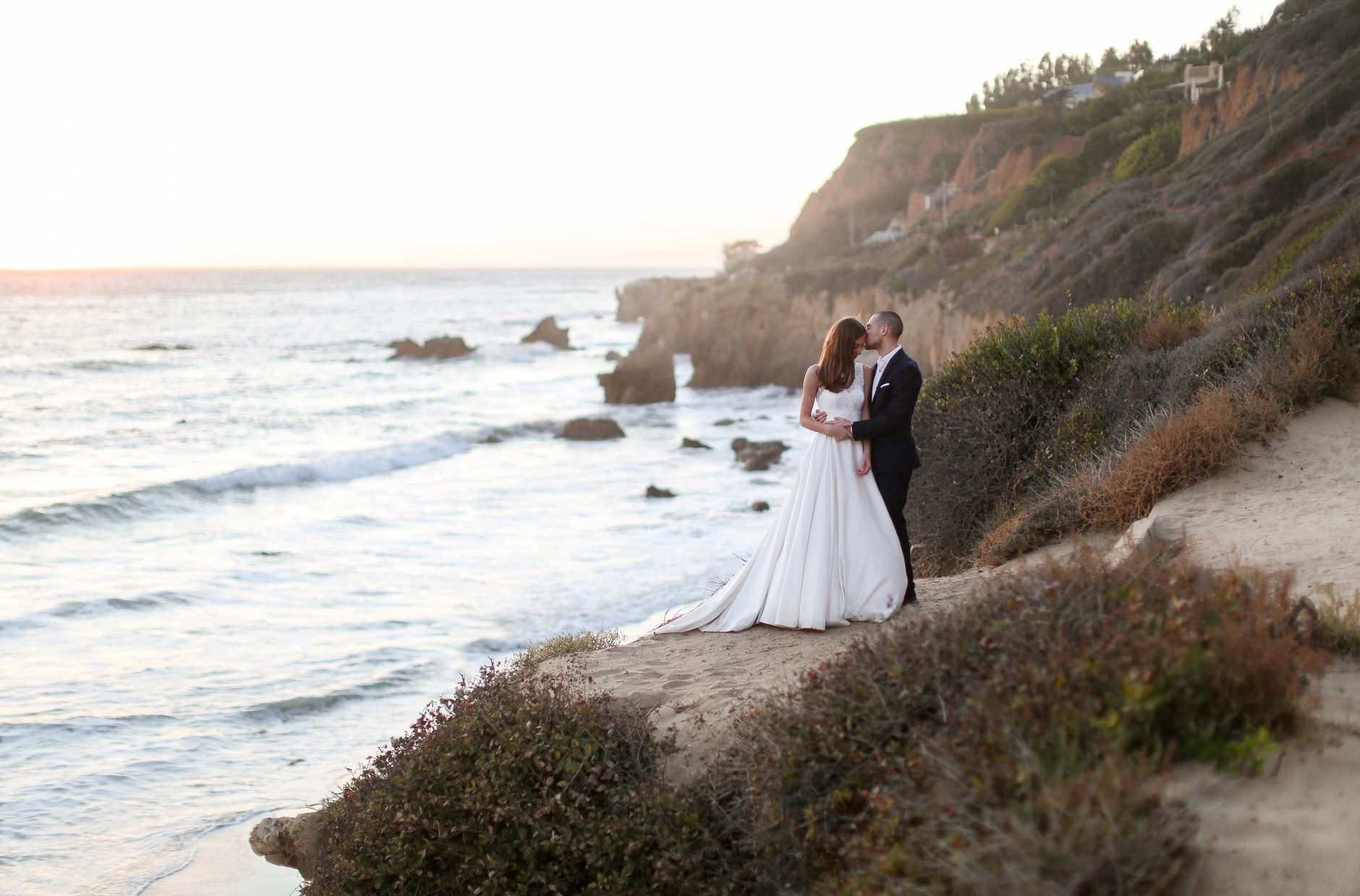
How do hidden photographer and videographer actually work during an elopement?
Photography and video coordination means the photographer is close but not obvious. During ceremony (5 minutes from first look to kiss), they're positioned low and to the side, shooting with a zoom lens so they're never in your sightline. After the kiss, they step into your view and direct you for ten to fifteen minutes of "just walk and talk" couple shots, bouquet toss, and champagne moments—you relax here because the hard part is done. The videographer works similarly: they film the whole ceremony with a static wide shot and a roaming close-up camera, capturing vow audio clearly (most couples cry or smile through their words—very raw, very needed in the video). By 9 a.m., the videographer has rough footage and can show you a thirty-second highlight reel on their phone, which almost always makes you cry again. The full video (three to five minutes) and photo gallery arrive within five to seven days; we host them in a private cloud link only you can access. If you want to share video with family later, we make a private YouTube link you can send via email—but most couples show family photos only and guard the video as sacred. Many couples also hire a "second photographer" who frames wide shots and detail moments (your rings, flowers, the meal) while the main photographer captures your faces.
How far in advance should you book a Hanoi, Hoi An, or Da Nang elopement?
Booking timelines vary by season. For October–November (peak, weather-safe, light is golden), book by late August if you want a specific venue; by mid-August we're down to second-choice sites because prime morning slots on mountaintops fill fast. For March–April (second-best season, less crowded), book by late January. For December–February (cool but sometimes hazy), book by September and prepare for a lower-haze-chance backup plan. June–August has fewer couples (monsoon risk, heat, humidity) and more venue availability, so booking three weeks out often works—but we build a robust rain backup because weather is less predictable. If you want to elope on a specific date (an anniversary, a lucky number, a dead relative's birthday), book eight to twelve weeks out; if you're flexible (any date in a three-week window), four to six weeks is enough. Tell us about your moment with your preferred month and region; we'll tell you the available dates and the best weather odds for each.
What if you're on a tight budget for an elopement?
Cost depends on location, guest count, and services; ask us for a quote on WhatsApp. Most couples ask if they can cut flowers, cake, or photography to save money—we don't recommend it. Here's why: elopement is one day, one moment, and photo/video is how you relive it forever; skipping photography means you only have phone selfies, which often have bad light and a missing partner. Cutting flowers means an arch or bouquet feels incomplete; cutting cake means no ceremony crescendo. Instead, we suggest trade-offs that don't hurt the day: elope on a Tuesday or Thursday (venues are often cheaper); choose a closer location (less drive time, lower planner coordination cost); skip a second photographer; do a quiet dinner for two instead of a dinner party. Some couples elope in a nearby city (Da Nang instead of a remote cave) where logistics are simpler. Others bundle elopement with a honeymoon or babymoon moment (e.g., elope in the morning, then have a romantic dinner as your honeymoon start) so you're paying one planner fee for two days instead of two separate events. The honest answer: you can elope for less money than a traditional wedding, but trying to go ultra-cheap often means you end up with a worse memory or stressed-out planning. Spend on what matters most to you (usually photography and the moment itself) and be flexible elsewhere.
What to check before you confirm your elopement
- Visa and passport: US passport valid for at least six months past your travel date. E-visa for Vietnam (online, processed in 1–3 days) or visa-free entry if you're US citizen (valid through 2025 for US citizens in 2026—check current rules). If renewing your passport, do it now; processing is slow.
- Weather window: Confirm monsoon season for your chosen region and whether you're okay with a rain pivot. If not, shift your date.
- Outfit and alterations: Order or rent ceremony clothes at least six weeks out; alterations take four to six weeks. Bring a backup outfit in your carryon in case luggage is delayed.
- Guest count and plus-ones: Tell us early if you want family or friends present; we need to arrange extra seating, transport, and meal counts by week two.
- Vow wording and music: Draft vows (you can read off a card—no one judges) and share your five favorite songs by week three so the musician or DJ can practice.
- Dietary needs: Tell us about allergies or strong food preferences by week four so the cake baker and dinner venue know.
- After-elopement plans: Will you share the news on social media? With family? When? This helps us coordinate timing and photo release permissions.
Why does coordination matter more for an elopement than a wedding?
An elopement has no wedding coordinator on-site (no planner friend or family), no rehearsal dinner to brief people, no second (or third) event if something goes sideways. It's just you, your partner, one day, and a team you've never met in person. Coordination matters because if the florist arrives late, your photographer has to grab a backup bouquet from a market; if the cake baker mixes up the flavor, you can't send a runner to the next bakery—you're stuck. That's why we manage every single vendor, call confirmations forty-eight hours before, have backup contacts for every role, and brief you on a WhatsApp call three days before so you know exactly what to expect and can tell us if anything feels wrong. We also coordinate the "unseen" moments: the musician calling us if they get lost, the videographer moving fast to catch your first kiss, the florist knowing your exact dress color so the bouquet isn't a clash—all of this happens because we're your translator, mediator, and problem-solver, not just a vendor list.
Tell us about your moment
Chat with a planner on WhatsApp
Read more stories from our planners
We've coordinated elopements on islands, in caves, on rooftops, and in monsoon backups that turned out better than the original plan. More stories from our planners show how couples decide, what they worried about, and what surprised them most.
Chat with a planner on WhatsApp
Pages from our team you may need
- marriage proposal planning
- anniversary celebration planning
- private romantic dinner setup
- flowers and bouquets
- custom cakes and desserts

FAQ
Do we need a visa to elope in Vietnam?
US citizens can enter Vietnam visa-free (valid through 2025 for travelers in 2026; verify current policy). If visa-free entry ends, you'll need an e-visa (apply online, three days, or a traditional visa from a consulate). Book your elope date once you've confirmed your passport is valid for at least six months past travel.
Can we elope with just the two of us, or do we need witnesses or guests?
Ceremony-only elopements (just you two and a photographer) are most common in our work. If you want family or close friends present, we arrange extra seating, transport, and meals; tell us by week two. If you want a legal Vietnam marriage certificate, two witnesses are required; this complicates logistics significantly—most couples marry legally at home first and elope ceremonially here.
What's the wettest month in Vietnam, and can we still elope?
August–September is wettest nationwide; May–July is wet in the south and central coast; December–February is dry everywhere. We never cancel for rain—we pivot to a backup venue—but couples who elope during monsoon months should expect a one- to two-day weather delay risk and accept a covered venue as primary. October–November and March–April are safest.
Can we elope spontaneously (less than two weeks out)?
Yes, but you'll have fewer venue choices, less time to plan specifics, and higher stress. We recommend at least four weeks so we can lock down a photographer, florist, and dinner venue without scrambling. Two-week elopements work if you're very flexible (any date, any backup location, simple cake and flowers).
What happens if we fight with our partner the night before?
We've seen cold feet, exhaustion, and real disagreements. Call us immediately—we'll listen, help you untangle, and often a WhatsApp call with your planner (who's neutral and has seen this before) helps couples remember why they're doing this. Very rarely does a couple call off—most tell us later they were just tired or scared, and the elopement healed whatever was sore.
Chat with a planner
Tell us the city, the date and the kind of moment. A planner replies on WhatsApp in English with ideas and what is possible.
FAQ
Do we need a visa to elope in Vietnam?
US citizens can enter Vietnam visa-free (valid through 2025 for travelers in 2026; verify current policy). If visa-free entry ends, you'll need an e-visa (apply online, three days, or a traditional visa from a consulate). Book your elope date once you've confirmed your passport is valid for at least six months past travel.
Can we elope with just the two of us, or do we need witnesses or guests?
Ceremony-only elopements (just you two and a photographer) are most common in our work. If you want family or close friends present, we arrange extra seating, transport, and meals; tell us by week two. If you want a legal Vietnam marriage certificate, two witnesses are required; this complicates logistics significantly—most couples marry legally at home first and elope ceremonially here.
What's the wettest month in Vietnam, and can we still elope?
August–September is wettest nationwide; May–July is wet in the south and central coast; December–February is dry everywhere. We never cancel for rain—we pivot to a backup venue—but couples who elope during monsoon months should expect a one- to two-day weather delay risk and accept a covered venue as primary. October–November and March–April are safest.
Can we elope spontaneously (less than two weeks out)?
Yes, but you'll have fewer venue choices, less time to plan specifics, and higher stress. We recommend at least four weeks so we can lock down a photographer, florist, and dinner venue without scrambling. Two-week elopements work if you're very flexible (any date, any backup location, simple cake and flowers).
What happens if we fight with our partner the night before?
We've seen cold feet, exhaustion, and real disagreements. Call us immediately—we'll listen, help you untangle, and often a WhatsApp call with your planner (who's neutral and has seen this before) helps couples remember why they're doing this. Very rarely does a couple call off—most tell us later they were just tired or scared, and the elopement healed whatever was sore.
More like this
Elopement and vow renewal
How to Plan an Elopement in Ha Long Bay: The Practitioner's Guide
Ha Long Bay elopements need timing around weather windows, fast vendor coordination, and a planner who keeps the secret. We walk you through every decision.
Elopement and vow renewal
How to Plan a Vow Renewal in Hoi An
A vow renewal in Hoi An means choosing a meaningful venue, coordinating your guests or keeping it intimate, and orchestrating flowers, a custom cake, music, and photography around your own ceremony. We help couples turn a personal milestone into a complete, memorable moment.
Elopement and vow renewal
Elopement for Tourists in Saigon: Plan Your Secret Wedding
Eloping in Saigon as a tourist couple means navigating visas, finding a legal venue, and coordinating vendors in a city where English isn't always spoken. Cáo Moments handles the entire day—from hidden photographer to custom cake and fresh flowers—so you can marry on your terms.